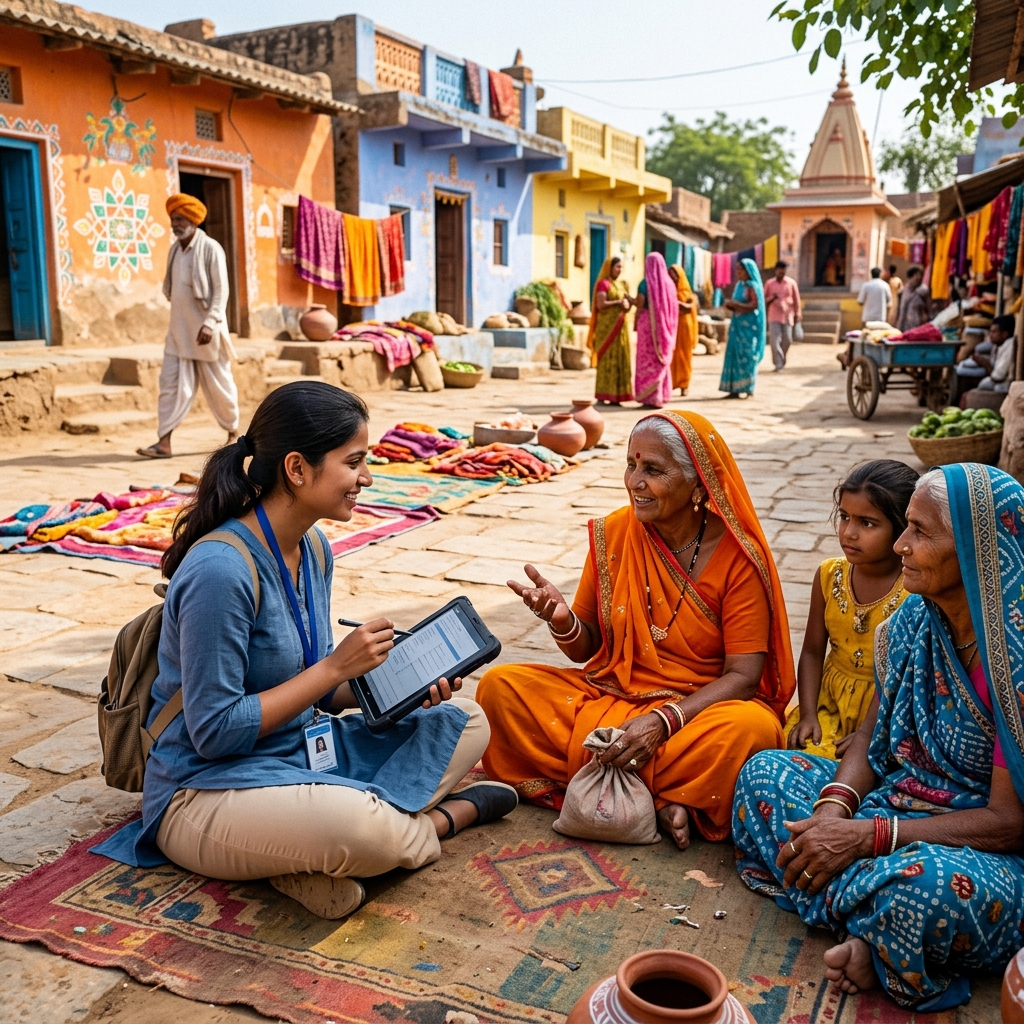
India conducts more elections than any other country on earth — national, state, local body, and by-elections running through almost every month of the calendar. This creates a constant, large-scale demand for pre-election opinion surveys, exit polls, and voter sentiment studies. Blue Projects is currently executing election survey operations in Karnataka. Here is what rigorous election survey methodology actually looks like on the ground — and where the ethical lines are.
Why most Indian election surveys are wrong — and how to avoid it
The credibility crisis in Indian election polling is real. Survey after survey has dramatically missed actual results — sometimes by 10–15 percentage points. The failures are rarely about the analysis. They are almost always about the data collection. Specifically:
- Convenience sampling: Interviewing people who are easy to access rather than those who represent the electorate. Roadside interviews, mall intercepts, and WhatsApp polls all produce highly biased samples.
- Social desirability bias: Respondents tell interviewers what they think the interviewer wants to hear, or what they believe is the socially acceptable answer — particularly on sensitive caste and community questions.
- Interviewer effects: The caste, community, gender, and language of the interviewer significantly affects responses. A Brahmin interviewer in a Dalit household gets different answers than a Dalit interviewer in the same household.
- Late swing: Indian voter decisions are frequently made in the last 72 hours, often after the final survey wave. Any survey completed more than a week before polling has limited predictive validity for close contests.
"A survey is only as good as its sample. And a sample is only as good as the system that generates it — not the intent of the surveyor."
Sampling design — the foundation of credible results
For a constituency-level survey, the minimum viable sample size for ±3% margin of error at 95% confidence is approximately 1,067 respondents. For ±5%, it drops to approximately 384. Most serious election surveys use 800–1,200 interviews per constituency.
The sampling approach we use:
- Stratified sampling by AC segment: The Assembly Constituency is divided into geographic segments (typically existing booth-level divisions). Sample allocation is proportional to registered voter population in each segment.
- Systematic random selection of polling booths: Within each segment, booths are selected using a random interval method from the official booth list.
- Random household selection: In the catchment area of each selected booth, households are selected using a random walk method with a skip interval determined by the total households and required sample from that booth.
- Within-household respondent selection: A Kish grid or birthday method is used to randomly select one eligible voter from each household — preventing interviewers from always selecting the most accessible or cooperative household member.
- Sampling frame based on official electoral rolls (not voter lists from parties)
- Written sampling protocol with random selection methodology clearly defined
- GPS coordinates for each interview location
- Interviewer identity and supervisor recorded for each questionnaire
- Back-check documentation (minimum 10% of all interviews)
- Date and time stamp on every completed interview record
Questionnaire design — what to ask and what never to ask
The sequence of questions in an election questionnaire is not arbitrary — it follows a logic designed to minimise anchoring and priming effects.
Standard question sequence:
- General political interest and participation (warm-up)
- Issues of concern — open-ended, unprompted (captures real salience before any candidate or party is mentioned)
- Performance rating of current government — national and state separately if relevant
- Voting intention — "If the election were held today, which party would you vote for?" (closed, with option to refuse)
- Candidate preference if voting intention is undecided
- Demographic questions — age, gender, occupation, caste/community (with careful framing)
Caste is the single most predictive variable in Indian election outcomes — and the most sensitive to ask about. The standard approach is to ask respondents to self-identify their community using a pre-coded list that is region-specific. Never ask "What caste are you?" — always "Which community do you belong to?" The framing matters significantly for response rates and accuracy.
CAPI field execution — the technology layer
All our election surveys use CAPI (Computer-Assisted Personal Interviewing) via the KoBoToolbox mobile app. CAPI provides three critical quality controls that paper questionnaires cannot:
- Skip logic enforcement: Interviewers cannot skip mandatory questions or apply incorrect skip patterns. The form enforces the questionnaire logic automatically.
- GPS and timestamp capture: Every submission is automatically tagged with the interviewer's GPS coordinates and the exact time the interview was conducted.
- Real-time data submission: Interviews are uploaded to the central server the moment the field agent has connectivity. The central team can see fieldwork progress in real time.
Interviewer training — the variable most survey agencies ignore
The difference between a credible election survey and a garbage one is almost entirely determined by interviewer quality. Our training for election survey interviewers covers:
- How to explain the survey purpose without biasing the respondent
- How to handle refusals — the protocol for when a household refuses to participate (move to the next household using the skip rule, do not substitute with a convenient respondent)
- How to probe neutral answers — getting the respondent to commit to a preference without leading them
- How to use the KoBo app for the specific questionnaire being deployed
- What constitutes data fabrication and why it has immediate consequences
Training takes a minimum of one full day — half day classroom, half day practice interviews in the field with supervisor observation and feedback.
MCC compliance — what every election survey operator must know
The Model Code of Conduct (MCC) comes into effect when elections are announced and imposes specific restrictions on survey and polling activities. Key requirements:
- Exit polls cannot be published until the final phase of voting closes — the restriction period is specified in the election schedule
- Opinion polls conducted during the MCC period must comply with representation of results guidelines (confidence intervals must be published alongside results)
- Survey agencies operating in polling areas during voting day must carry identification and permission from the Election Commission
- Any survey that can be construed as political advertising requires declaration and compliance with campaign finance rules
All Blue Projects election survey operations are conducted with legal review of MCC applicability before fieldwork begins. Our field teams carry identity documents, supervisor contact information, and written authorisation from our client. We do not conduct or publish exit poll data in violation of EC timelines under any circumstances.
The ethical lines — what we will and will not do
Election survey work is ethically complex because the results influence public perception, media coverage, and sometimes voter behaviour itself. Our clear positions:
- We do not fabricate or adjust data to produce a desired result for a client, regardless of commercial pressure
- We do not conduct push polls — surveys designed to influence rather than measure opinion by embedding biased messaging in question framing
- We do not share raw data with political parties, candidates, or campaign organisations without the explicit knowledge and consent of our research client
- We do report our methodology when results are published — sample size, dates of fieldwork, margin of error, and sampling method should always accompany published survey results
These are not just ethical positions — they are operational standards that protect our credibility and the value of our work over time. A survey agency that produces what clients want to hear rather than what the data says is not an asset to any client for more than one election cycle.